THE MET
Cream Cotton Muslin Empire Waist Dress
Empire / Regency · 1810s · French
Production
handmade
Material
cotton muslin
Culture
French
Influences
neoclassical Greek chiton · Josephine Bonaparte court style
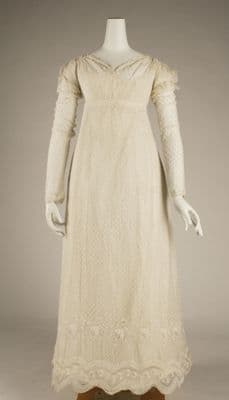
This Empire period dress displays the characteristic high waistline positioned just below the bust, creating the columnar silhouette popular during the Napoleonic era. The cotton muslin fabric features an allover woven or embroidered geometric diamond pattern that adds subtle texture to the surface. Long fitted sleeves extend to the wrists with gathered fullness at the shoulders. The neckline forms a modest V-shape with decorative trim or embroidery along the edges. The skirt falls in straight, unstructured lines from the empire waist to floor length, ending with an elaborate scalloped hem border featuring intricate whitework embroidery or lace insertion. This construction reflects the neoclassical aesthetic that dominated early 19th century fashion, emphasizing natural body lines and classical Greek proportions.
dressa-linesquare necklinefloor length
Connected To
Influences·neoclassical Greek chitonWorn with·chemise
SHARED10 years · cross-culture
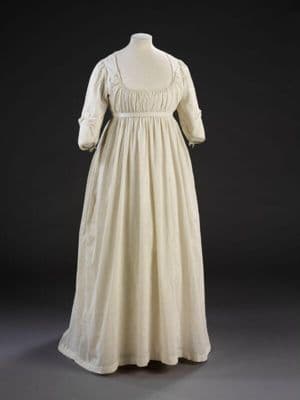
These two gowns reveal how the Empire waist became fashion's great equalizer across early 19th-century Europe, transforming women into walking columns whether they lived in Paris or London. The French dress shows the style at its most refined—that delicate dotted muslin and scalloped hem speak to the Napoleonic court's taste for classical restraint with just enough ornamentation to signal luxury.
Pull the Thread→
Follow this garment wherever the graph leads