1950s · 1940s · Western
Production
ready-to-wear
Material
wool suiting
Culture
Western
Movement
New Look / Post-War
Influences
American sportswear simplicity
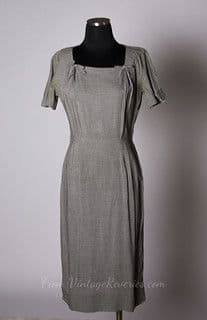
A precisely tailored sheath dress in light gray wool suiting fabric with subtle darker gray contrast trim. The dress features a square neckline with short sleeves and follows the body's natural silhouette without excess volume. Dark gray piping or trim accents the neckline and appears to continue down the front, creating clean geometric lines. The construction demonstrates skilled tailoring with sharp, pressed edges and structured fit typical of 1950s ready-to-wear. The knee-length hemline and streamlined cut reflect the post-war shift toward practical elegance and the emerging American sportswear aesthetic that emphasized wearable sophistication over elaborate ornamentation.


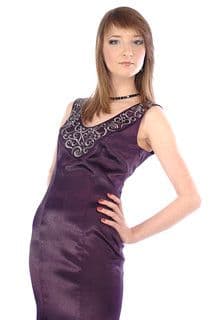
Both dresses understand that a sheath's power lies in its restraint — the gray 1950s wool with its knife-sharp tailoring and the purple silk satin with its whisper of paisley both refuse embellishment in favor of pure line. The older dress achieves its authority through military precision (notice how those darts could cut glass), while the modern version seduces through fabric alone, letting that liquid satin do the work that structured seaming once did.


Follow this garment wherever the graph leads
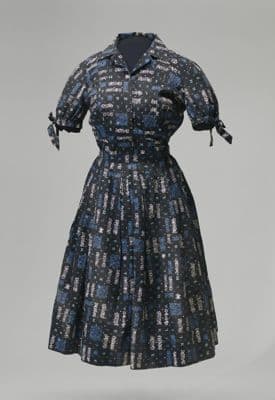
These two dresses reveal the split personality of 1950s American womanhood: the cheerful suburban housewife versus the serious working girl. The navy shirtdress with its busy geometric print and tie sleeves practically bounces with domestic optimism, while the gray wool sheath—with its stark neckline and unforgiving pencil silhouette—means business in the most literal sense.
These two 1950s dresses reveal the democratic reach of Christian Dior's New Look, though filtered through vastly different economic realities.
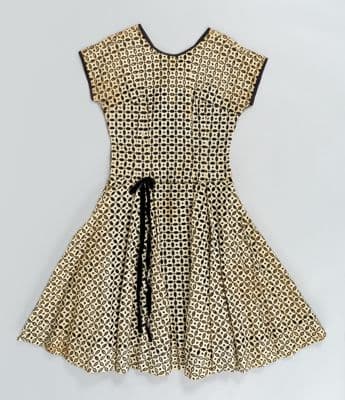
These dresses reveal how Christian Dior's New Look translated across economic strata in 1950s America. The gray wool sheath channels the couture version — that precise waist suppression, the calculated curve from bust to hip — while the cotton eyelet dress democratizes the same silhouette through a flared skirt that achieves New Look proportions with yards of affordable fabric instead of expert tailoring.
Both dresses understand that a sheath's power lies in its restraint — the gray 1950s wool with its knife-sharp tailoring and the purple silk satin with its whisper of paisley both refuse embellishment in favor of pure line. The older dress achieves its authority through military precision (notice how those darts could cut glass), while the modern version seduces through fabric alone, letting that liquid satin do the work that structured seaming once did.