1990s · 2020s · Western
Production
ready-to-wear
Material
jersey knit
Culture
Western
Movement
Minimalism
Influences
1970s wrap dress silhouette
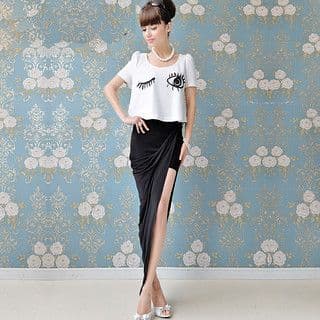
A black jersey knit maxi skirt with an asymmetrical wrap construction that creates a dramatic side slit extending from mid-thigh to hem. The skirt sits at the natural waist and follows the body's contours closely through the hips before falling in a straight column to ankle length. The wrap detail creates visual interest through its diagonal line and functional closure. Paired with a white graphic t-shirt featuring black eye and lip motifs, the ensemble demonstrates the minimalist aesthetic's emphasis on clean lines and monochromatic color schemes. The jersey fabric's stretch properties allow for the close fit while maintaining comfort and movement.
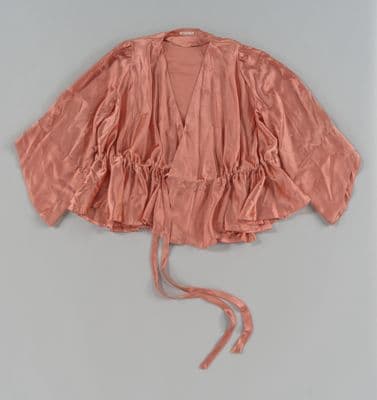
The coral wrap blouse and the black jersey skirt are separated by decades but united by the same seductive logic: fabric that clings, then releases, controlled by nothing more than a strategic tie. The blouse's billowing sleeves and gathered waist echo the 1970s wrap dress revolution that Diane von Furstenberg unleashed, while the skirt's asymmetrical drape and thigh-high slit updates that same "unwrap me" sensuality for the body-conscious '90s.

The coral wrap blouse and the black jersey skirt are separated by decades but united by the same seductive logic: fabric that clings, then releases, controlled by nothing more than a strategic tie. The blouse's billowing sleeves and gathered waist echo the 1970s wrap dress revolution that Diane von Furstenberg unleashed, while the skirt's asymmetrical drape and thigh-high slit updates that same "unwrap me" sensuality for the body-conscious '90s.


Follow this garment wherever the graph leads
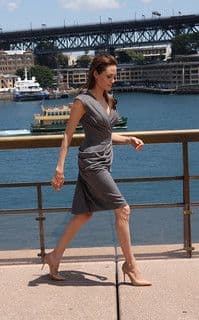
Both garments speak the same body-conscious language of the wrap, where jersey knit becomes sculpture through strategic draping and gathering. The gray dress distills Diane von Furstenberg's 1970s wrap formula into a sleek, above-the-knee statement, while the black skirt takes that same twisted-and-tied DNA and stretches it into asymmetrical territory—one side pooling at the ankle, the other slashed high on the thigh.
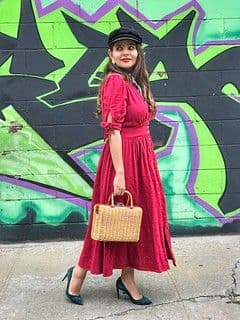
The wrap dress's billowing red sleeves and the asymmetrical skirt's body-conscious drape represent two sides of Diane von Furstenberg's revolutionary 1970s wrap silhouette — one embracing the original's easy bohemian spirit, the other distilling its seductive geometry into pure minimalism. Where the dress plays up the wrap's casual charm with gathered fabric and mid-length propriety, the skirt strips away everything but the essential diagonal line and that strategic gap of exposed leg.
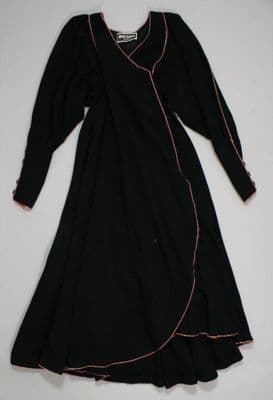
That black wool wrap dress from the 1970s, with its deep V-neck and bee button detail trailing down the asymmetrical closure, is the DNA ancestor of the sleek jersey wrap skirt that follows two decades later. Both garments understand that the wrap's power lies in its diagonal line cutting across the body—the dress sweeping dramatically to the floor, the skirt creating that high-low hemline with a thigh-baring slit.