THE MET
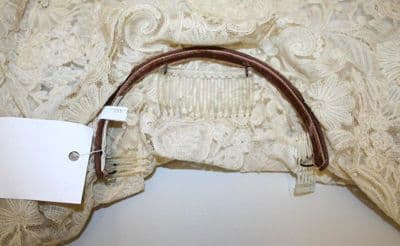
Cotton Lace Wedding Veil with Floral Pattern
Victorian Late / Bustle · 1870s-1880s · European
Production
mass-produced
Material
cotton lace
Culture
European
Influences
Victorian bridal traditions
A Victorian wedding veil constructed from fine cotton lace featuring an intricate floral pattern with delicate scrollwork and botanical motifs. The lace displays machine-made characteristics typical of the late 19th century, with uniform mesh ground and precisely repeated design elements. The veil appears to have a scalloped or shaped edge and would have been worn draped over the bride's head and extending down the back. A brown leather or fabric band is visible, likely serving as an attachment mechanism or storage element. The cream-colored lace shows the refined needlework techniques that made wedding veils precious family heirlooms during the Victorian era.
headband/head covering/hair accessoryfloor length
Connected To
Worn with·wedding dressFunction·wedding
SHARED80 years · cross-culture
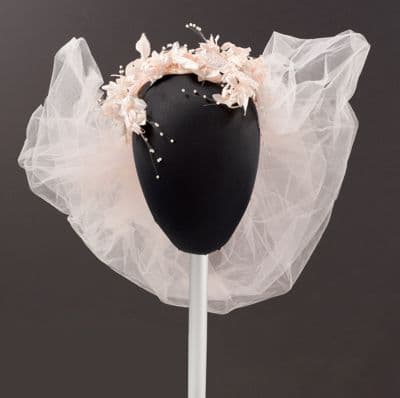
These veils reveal how bridal headwear morphed from Victorian excess to mid-century restraint while keeping the same romantic DNA. The earlier piece drowns in heavy cotton lace worked into elaborate floral motifs—a textile tour de force that would have taken months to complete—while the 1950s version distills that floral impulse into a few silk blooms scattered across gossamer tulle that barely whispers against the bride's shoulders.
Text71%
Image72%
Entity28%
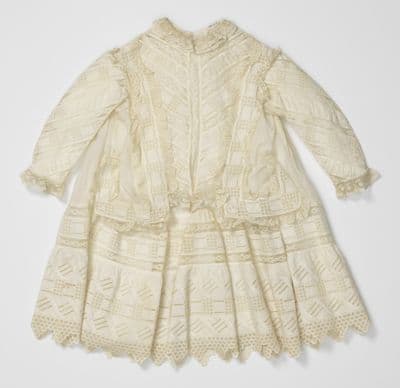
Worn with·petticoatTechnique·laceworkTechnique·machine-embroidery
SHAREDsame era · cross-culture · cross-category
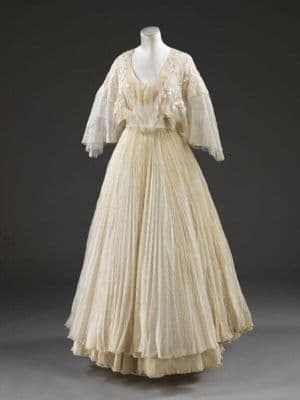
Worn with·petticoatFunction·wedding
SHARED90 years · cross-culture · cross-category
Text70%
50%
Worn with·corsetWorn with·petticoat
SHARED20 years · cross-culture · cross-category
Text71%
Pull the Thread→
Follow this garment wherever the graph leads