THE MET
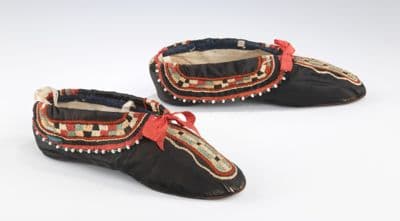
Black Silk Evening Slippers with Red Trim
Empire / Regency · 1810s · British
Production
handmade
Material
silk
Culture
British
Influences
Turkish slipper styling · Regency pointed toe fashion
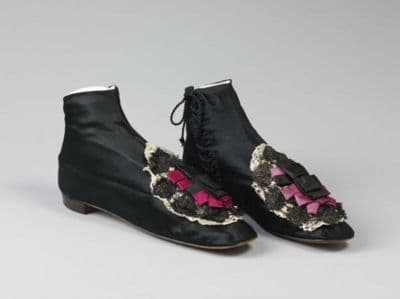
A pair of black silk evening slippers with dramatically pointed toes characteristic of Regency footwear. The uppers feature elaborate trim in red silk with cream and gold decorative elements, including what appears to be geometric patterning and small metallic studs or beads. Red silk ribbon ties cross over the low-cut vamp and around the ankle. The construction shows typical early 19th-century slipper making with minimal heel elevation and a narrow, elongated silhouette that would have been worn with high-waisted Empire gowns. The decorative treatment reflects the period's taste for contrasting color combinations and surface ornamentation on formal accessories.
shoetight fit
Connected To
Worn with·evening gownWorn with·stockingsFunction·court-formal
SHARED90 years · cross-culture
These slippers trace the elegant arc of formal footwear across nearly a century, from the Empire period's architectural restraint to the Belle Époque's curvilinear grace. The earlier black pair, with its geometric red and white trim and ribbon ties, speaks to Regency formality—that sharp-edged classicism where even decoration followed rules—while the navy satin slipper abandons such rigid ornament for the sinuous bow and gentle curves that defined 1890s femininity.
Text81%
Image79%
Worn with·evening gownTechnique·beadworkFunction·court-formal
SHARED70 years · cross-culture · cross-category
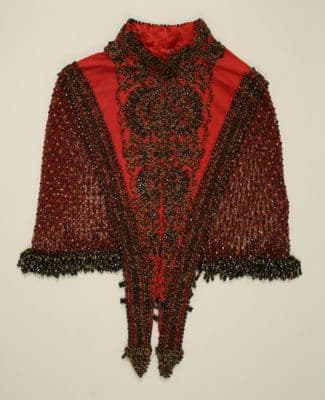
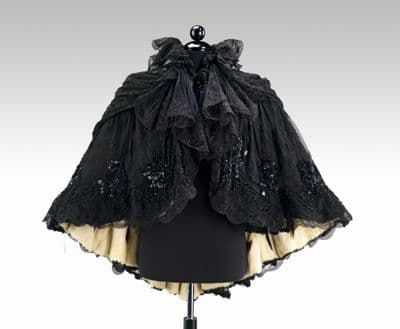
These pieces speak the same language of evening grandeur, separated by seven decades but united in their devotion to meticulous beadwork as the ultimate mark of luxury.
Worn with·evening gownTechnique·beadworkFunction·court-formal
SHARED70 years · cross-culture · cross-category
These pieces speak the same language of aristocratic mourning dress, where grief became a form of luxury performance. The Empire slippers' coral-red ribbon trim against black silk mirrors the cape's jet beading against black — both using ornament to animate darkness rather than relieve it.
Worn with·evening gownTechnique·beadwork
SHARED150 years · cross-culture · cross-category
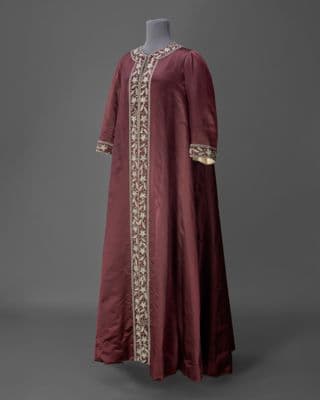
These two pieces speak the same decorative language across a century and a half: intricate beadwork that transforms simple silhouettes into something precious. The Regency slippers deploy tiny beads and metallic trim like jewelry for the feet, creating delicate borders that frame the black silk, while the 1960s evening coat uses similar beaded embellishment to outline its flowing lines in what appears to be gold or cream against the deep burgundy.
Echoes Across Time
Empire / Regency → Fin de Siecle / Gibson Girl · 90yr62%
SHARED
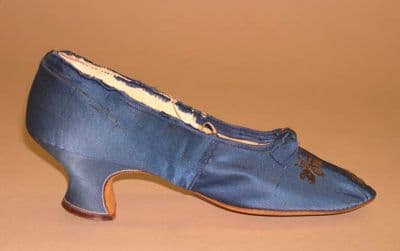
These slippers trace the elegant arc of formal footwear across nearly a century, from the Empire period's architectural restraint to the Belle Époque's curvilinear grace. The earlier black pair, with its geometric red and white trim and ribbon ties, speaks to Regency formality—that sharp-edged classicism where even decoration followed rules—while the navy satin slipper abandons such rigid ornament for the sinuous bow and gentle curves that defined 1890s femininity.
Worn with·evening gownWorn with·stockingsFunction·court-formal
Pull the Thread→
Follow this garment wherever the graph leads