V&A
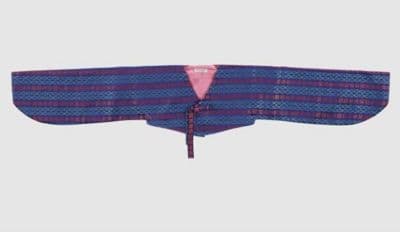
Deep Purple Silk Korean Jeogori Overjacket
Korean Traditional · 1980s · Korean
Production
handmade
Material
silk
Culture
Korean
Influences
traditional Korean hanbok · Joseon dynasty court dress
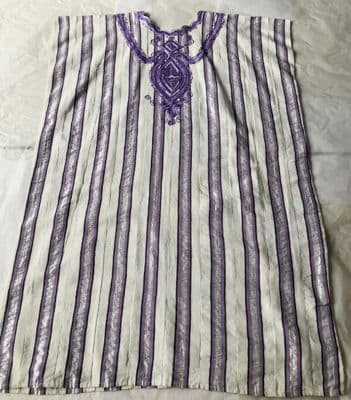
A traditional Korean overjacket featuring a short, cropped silhouette with wide, extended sleeves that create a dramatic horizontal line. The garment displays intricate geometric striping in deep purple, magenta, and teal blue silk, with fine linear patterns running horizontally across the fabric. The construction shows a fitted bodice with a central front closure marked by decorative ties or fastenings. The sleeve construction appears to follow traditional Korean hanbok proportions, with the wide sleeves extending well beyond the natural arm span. The fabric shows a lustrous silk finish with precise geometric patterning that suggests traditional Korean textile techniques. The overall form maintains the characteristic Korean aesthetic of balanced proportions between fitted torso and expansive sleeve volume.
jacketfittedv-neckabove-the-hip
Connected To
Influences·Joseon dynasty court dressFunction·religious-ceremonialMotif·
Echoes Across Time
Korean Traditional → Great Depression · 50yr68%
SHARED
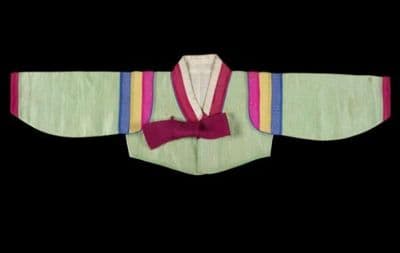
These two jeogori jackets reveal how Korean traditional dress held its formal DNA steady even as color palettes shifted with the times. The earlier deep purple piece carries the weight of Joseon court tradition in its saturated hue and precise geometric banding, while the Depression-era jacket lightens to pale green with vivid magenta and blue accents—a palette that feels almost optimistic against the economic darkness of the 1930s.
Influences·Joseon dynasty court dressFunction·religious-ceremonialMotif·stripe-band
Pull the Thread→
Follow this garment wherever the graph leads