V&A
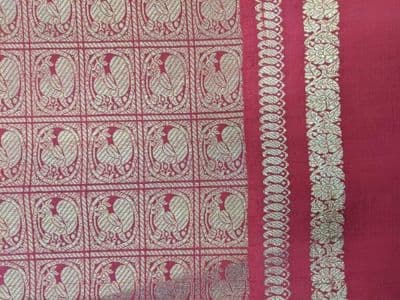
Red Silk Kanchipuram Sari with Gold Brocade
Indian Traditional · 1950s · Indian
Production
handmade
Material
silk brocade
Culture
Indian
Influences
traditional South Indian temple textile design
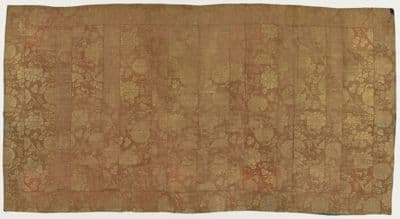
This Kanchipuram silk sari displays the characteristic heavy brocade weaving technique of Tamil Nadu's temple textiles. The deep red silk ground features repeating geometric compartments, each containing stylized floral and bird motifs rendered in gold metallic thread. The intricate brocade work creates raised surface texture through supplementary weft technique. A wide decorative border runs along one edge with elaborate gold patterning, while a narrower coordinating border frames the opposite side. The metallic threads catch light, creating dimensional contrast against the matte red silk base. This type of heavy silk brocade requires specialized handloom techniques and represents the pinnacle of South Indian textile craftsmanship, traditionally woven for temple offerings and ceremonial occasions.
dressfloor length
Connected To
Worn with·blouseWorn with·petticoatTechnique·hand-weaving
SHARED60 years
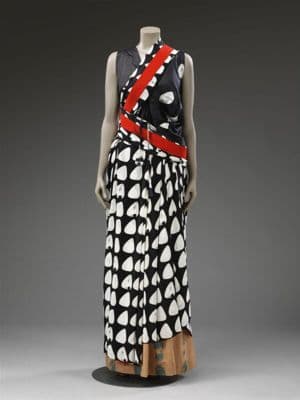
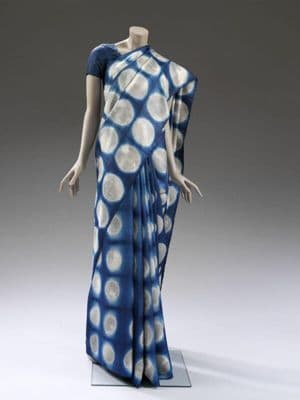
These saris reveal how Indian textile traditions encode meaning through radically different visual languages—the indigo tasar's loose, organic circles floating like scattered moons against deep blue, versus the Kanchipuram's regimented gold brocade grid that locks each motif into geometric precision. The first whispers of village looms and natural dyes, while the second announces temple town grandeur with its metallic threads that catch light like armor.
Worn with·blouseWorn with·petticoat
SHARED60 years
Text64%
Technique·brocade-weavingFunction·religious-ceremonial
SHARED335 years · cross-culture · cross-category
Text64%

Worn with·blouse
SHARED30 years · cross-culture · cross-category
Text32%
Image54%
Echoes Across Time
Traditional Indian → Indian Traditional · 60yr59%
SHARED
These saris reveal how Indian textile traditions encode meaning through radically different visual languages—the indigo tasar's loose, organic circles floating like scattered moons against deep blue, versus the Kanchipuram's regimented gold brocade grid that locks each motif into geometric precision. The first whispers of village looms and natural dyes, while the second announces temple town grandeur with its metallic threads that catch light like armor.
Worn with·blouseWorn with·petticoatTechnique·hand-weaving
Pull the Thread→
Follow this garment wherever the graph leads