1990s · 1990s · Hong Kong
Production
mass-produced
Material
printed cotton
Culture
Hong Kong
Movement
Pop Art · Grunge
Influences
Andy Warhol pop art portraits · 1960s political graphic design
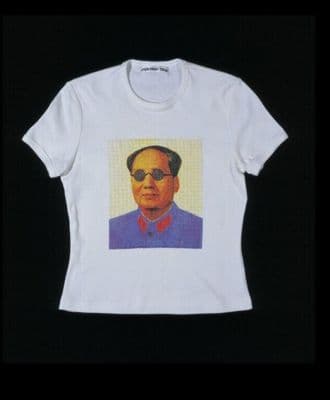
A white cotton t-shirt featuring a large screen-printed graphic of Chairman Mao Zedong rendered in Andy Warhol's pop art style with vibrant purple, orange, and yellow coloring. The portrait occupies the center front of the garment, showing Mao wearing his characteristic Mao suit. The t-shirt has a classic crew neckline and short sleeves with a standard relaxed fit typical of 1990s casual wear. This piece represents the intersection of political imagery, pop art aesthetics, and streetwear culture that emerged in Hong Kong during the mid-1990s, combining Western artistic movements with Chinese political iconography in wearable form.
Follow this garment wherever the graph leads
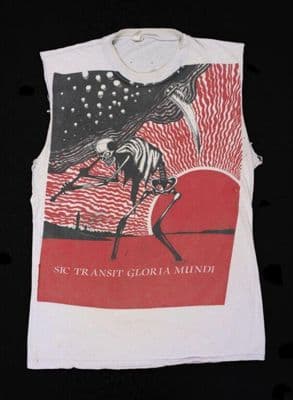
These two shirts capture the exact moment when grunge's anti-establishment fury collided with high art's subversive streak—one brandishing Warhol's psychedelic Mao like a middle finger to both communism and capitalism, the other wielding abstract expressionist chaos as armor against conformity.
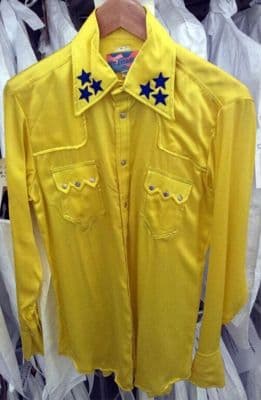
That Warhol Mao tee and the glam cowboy shirt are both acts of cultural piracy, just working different sides of the street. The white cotton tee lifts Warhol's subversive portrait—itself a theft of Communist iconography—and turns political provocation into mall-friendly merch, while the yellow satin western shirt with its star-studded collar points steals American frontier mythology for British rock-and-roll theater.
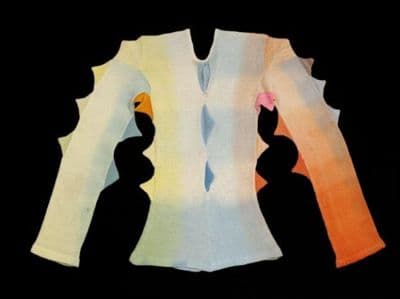
These two pieces trace pop art's journey from high concept to street level, both using the human silhouette as a canvas for bold graphic statements. The 1970s sweater transforms bodies into living sculptures with its gradient color-blocking and organic cutout shapes, while the 1990s tee flattens Warhol's iconic Mao into mass-market irony. What connects them is pop art's core promise: that everyday objects—whether a knitted pullover or a basic tee—can carry the same visual punch as gallery walls.
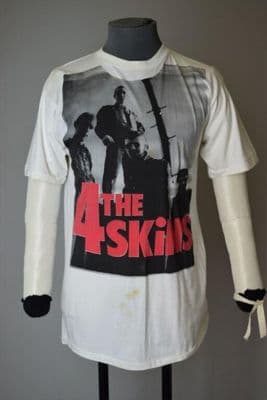
Both shirts weaponize the white cotton tee as a canvas for subversive imagery, but they're aiming at different targets. The Asking Alexandria shirt deploys the classic band tee formula—stark silhouettes against white cotton, selling rebellion as lifestyle—while the Mao portrait tee performs a more pointed cultural jujitsu, turning Warhol's pop art treatment of the Communist leader into wearable provocation.