V&A
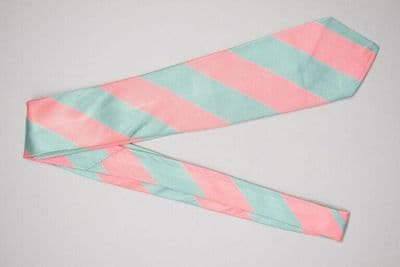
Salmon Pink Mint Green Striped Silk Club Tie
1950s · 1960s-1980s · British
Production
ready-to-wear
Material
silk
Culture
British
Movement
Atomic Age
Influences
British regimental stripe tradition
A traditional British club tie featuring bold diagonal stripes in alternating salmon pink and mint green. The tie displays the classic regimental stripe pattern associated with gentleman's clubs, with stripes running from upper left to lower right. The silk fabric has a smooth, lustrous finish typical of quality neckwear. The tie appears to be of standard width for the period, approximately 3.5 inches at its widest point. The Garrick Club's distinctive pink and green colorway represents one of London's most prestigious theatrical and literary clubs, founded in 1831. The diagonal stripe construction creates a dynamic visual rhythm while maintaining the conservative aesthetic expected of traditional club regalia.
tie
Connected To
Worn with·dress shirtWorn with·suit jacketTechnique·machine-weavingFunction·court-formalMotif·stripe-band
SHAREDcross-culture
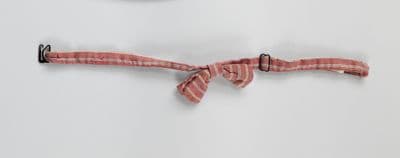
The red gingham bow tie and the salmon-pink club tie are separated by a decade and an ocean, but they're both products of mid-century men learning to dress down their formality. The bow tie's humble cotton checks speak to wartime pragmatism—when silk was scarce and ostentation felt wrong—while the club tie's jaunty prep-school stripes in ice cream colors announce the return of peacetime optimism and leisure.
Text
Worn with·dress shirtWorn with·suit jacketTechnique·machine-weavingMotif·stripe-band
Worn with·dress shirtWorn with·suit jacketTechnique·machine-weavingMotif·stripe-band
56%
Worn with·dress shirtWorn with·suit jacket
SHAREDcross-culture · cross-category
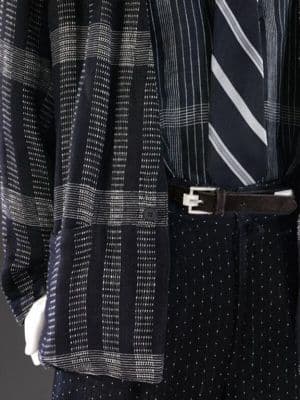
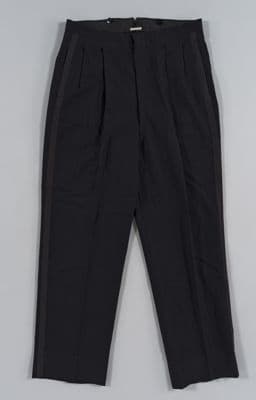
These pieces share the crisp geometry of mid-century menswear tailoring, though separated by three decades and an ocean. The trousers' knife-sharp pleats echo the tie's clean diagonal stripes—both rely on precise linear repetition to create visual interest from fundamentally conservative silhouettes.
Pull the Thread→
Follow this garment wherever the graph leads