
SMITHSONIAN
Dusty Rose Cotton Toile Pastoral Print
Neoclassical Transition · 1780s · English
Production
handmade
Material
cotton
Culture
English
Movement
Romanticism
Influences
French toile de Jouy
This is a classic toile de Jouy textile featuring pastoral scenes printed in dusty rose on cream cotton. The repeating pattern depicts idyllic farm life with figures in 18th-century dress engaged in rural activities, buildings, trees, and livestock scattered across the composition. The monochromatic printing technique creates varying tones through line density and cross-hatching. The scenes are arranged in a scattered, non-geometric layout typical of French toile designs that became popular in England during this period. The cotton ground fabric shows the fine weave characteristic of quality 18th-century textiles, while the pastoral subject matter reflects the Romantic idealization of rural life popular during the Neoclassical transition.
Connected To
Technique·block-printing
LINEAGE190 years · cross-culture · cross-category→ directed
Lineage: “pastoral romanticism”
The 18th-century toile's bucolic scenes—shepherds, ruins, grazing sheep rendered in that signature dusty rose—find their descendant in this 1970s shirt's burgundy pastoral vignettes, both born from the same copper-plate printing tradition that made French toile de Jouy famous.
Text77%
Image64%
Entity20%
LINEAGE40 years · cross-culture · cross-category→ directed
Lineage: “pastoral genre painting”
Text62%
Image56%
Echoes Across Time
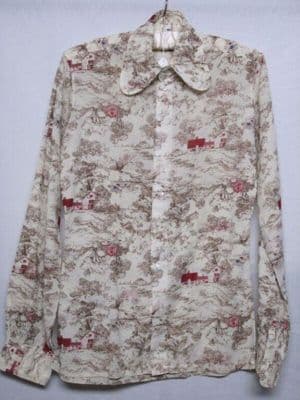
Neoclassical Transition → 1970s · 190yr52%
LINEAGE
The 18th-century toile's bucolic scenes—shepherds, ruins, grazing sheep rendered in that signature dusty rose—find their descendant in this 1970s shirt's burgundy pastoral vignettes, both born from the same copper-plate printing tradition that made French toile de Jouy famous.
Technique·block-printing
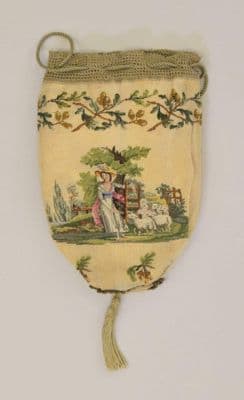
Neoclassical Transition → Empire / Regency · 40yr39%
LINEAGE
Pull the Thread→
Follow this garment wherever the graph leads