V&A
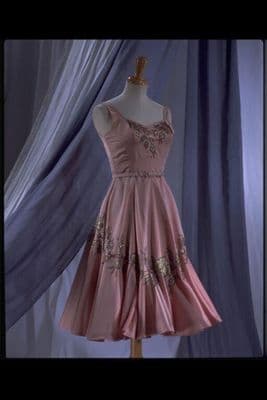
Embroidered Silk Satin Evening Dress with Belt
1950s · 1950s · British
Designer
Owen Hyde Clark for Worth London
Production
haute couture
Material
silk satin
Culture
British
Movement
New Look · New Look / Post-War
Influences
Christian Dior New Look · 1950s hourglass silhouette
This mid-1950s evening dress exemplifies the New Look silhouette with its fitted strapless bodice and voluminous circle skirt that falls to mid-calf length. The dusty rose silk satin is embellished with elaborate gold and cream embroidered floral motifs concentrated on the bodice and scattered across the skirt hem. The bodice features a sweetheart neckline with structured boning for support, while the skirt's generous fullness would require substantial petticoats underneath. A matching fabric belt with embroidered detailing cinches the natural waistline, emphasizing the hourglass silhouette characteristic of post-war formal wear. The hand-embroidered botanical designs show fine craftsmanship typical of London couture houses.
dressfit and flaresweetheartmidi
Connected To
Worn with·crinoline petticoatWorn with·strapless braTechnique·couture-construction
Echoes Across Time
Romantic → 1950s · 115yr67%
SHARED
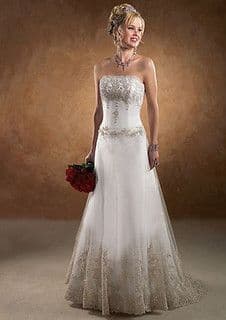
The strapless bodice that cradles the contemporary bride's torso echoes the same architectural challenge Christian Dior solved in 1955: how to make a woman's dress appear to float without visible means of support. While Dior's rose-pink silk relies on precise internal boning and that distinctive sweetheart neckline to create his New Look silhouette, the modern gown translates this engineering into cascading tulle and strategic lace appliqué that pools at the hem.
Worn with·crinoline petticoatWorn with·strapless braTechnique·couture-construction
Pull the Thread→
Follow this garment wherever the graph leads