1950s · 1960s · American
Designer
Ann Lowe
Production
haute couture
Material
silk charmeuse damask
Culture
American
Movement
New Look / Post-War
Influences
1950s New Look silhouette · Victorian ball gown proportions
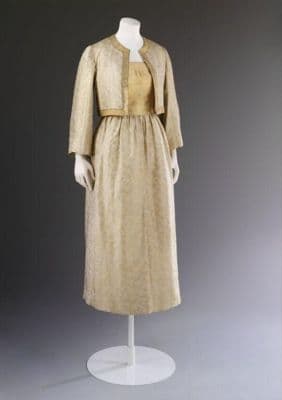
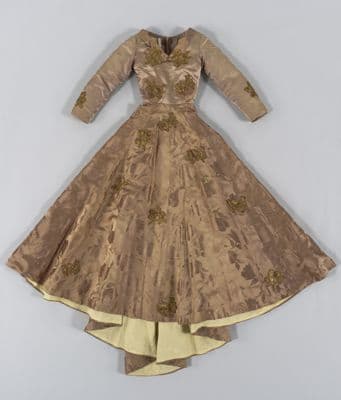
This formal evening gown features a fitted bodice with three-quarter length sleeves and a dramatically full skirt that extends into a train. The silk charmeuse damask displays an elaborate woven floral pattern in golden brown tones against a lighter ground. The bodice appears to have a modest neckline and is precisely tailored to the torso. The skirt's voluminous silhouette suggests substantial underlining or crinolines, characteristic of 1950s-60s formal wear. The train extends gracefully behind, with cream-colored lining visible at the hem. The damask weaving creates rich textural depth through the raised floral motifs, demonstrating the luxury textile work typical of haute couture evening wear of this period.


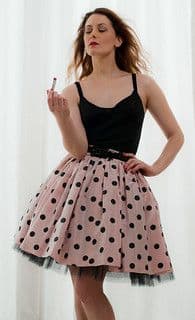
That golden damask gown from the 1950s and this millennial tulle confection are separated by six decades but united by their devotion to Dior's New Look silhouette—the nipped waist blooming into a bell of fabric that makes walking an event. The earlier dress achieves its drama through sheer volume and the weight of silk brocade, while the pink skirt relies on tulle's architectural bounce and those cheeky polka dots to create movement.

Follow this garment wherever the graph leads
Both gowns speak the same postwar language of abundance, but through different cultural vocabularies. The American damask dress channels New Look opulence with its sweeping circle skirt and fitted bodice, the rich brown silk woven with what appears to be floral motifs that catch light like jewelry.
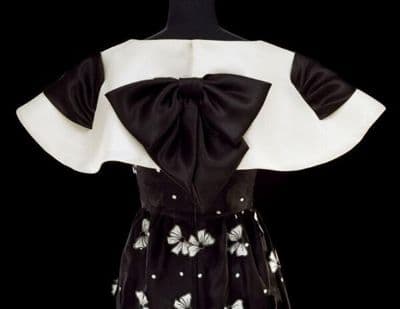
The 1950s gown's golden damask and fitted bodice extending into a full circle skirt speaks the same formal language as the 1980s dress's dramatic black bow and voluminous white sleeves, but where the earlier piece whispers elegance through its lustrous brocade and controlled silhouette, the later dress shouts it through stark contrast and theatrical proportions.
That golden damask gown from the 1950s and this millennial tulle confection are separated by six decades but united by their devotion to Dior's New Look silhouette—the nipped waist blooming into a bell of fabric that makes walking an event. The earlier dress achieves its drama through sheer volume and the weight of silk brocade, while the pink skirt relies on tulle's architectural bounce and those cheeky polka dots to create movement.
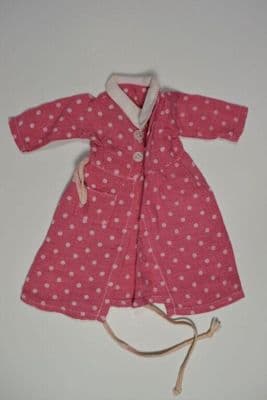
These two pieces reveal how Christian Dior's New Look democracy worked across every scale of 1950s life. The golden silk evening gown's fitted bodice blooming into a full circle skirt mirrors exactly the same proportional logic as the tiny pink polka-dot doll dress—both built on that revolutionary post-war silhouette that cinched waists and celebrated fabric abundance.

Both dresses worship at the altar of Dior's New Look, but they're separated by four decades of evolving femininity. The 1950s gown commits fully to the fantasy—that golden damask catches light like armor, the sleeves suggest propriety while the full skirt demands space in any room, and the subtle train whispers old Hollywood glamour.