THE MET
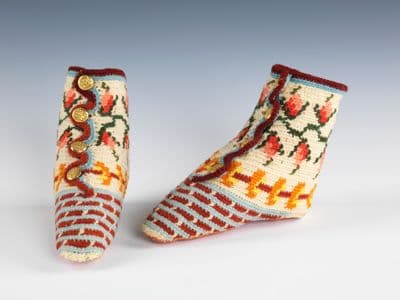
Hand-Knitted Wool Bootees with Colorwork Patterns
Victorian Late / Bustle · 1870s · American
Production
handmade
Material
wool
Culture
American
Influences
Scandinavian stranded knitting · Pennsylvania German folk patterns
A pair of hand-knitted wool bootees featuring intricate colorwork patterns in cream, red, orange, and green yarns. The ankle-high socks display geometric and floral motifs worked in stranded knitting technique, with horizontal striped bands alternating with pictorial designs that include stylized flowers and geometric shapes. The heel and toe areas show reinforcement stitching, while the cuff is finished with a contrasting red edge binding. The construction demonstrates skilled domestic needlework typical of Victorian-era home production, with tight, even gauge and complex multi-color patterning that would have required considerable knitting expertise to execute.
shoe
Connected To
50%
Technique·knitting
LINEAGE60 years · cross-culture · cross-category→ directed
Lineage: “Pennsylvania German folk patterns”
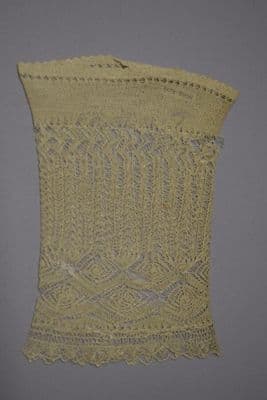
These two pieces trace the migration of European folk knitting across the Atlantic, where intricate cable patterns gave way to bold colorwork storytelling. The English mittens display the mathematical precision of Aran-style cables—those interlocking diamonds and twisted stitches that required memorized sequences passed down through generations—while the American bootees translate that same domestic virtuosity into pictorial motifs, trading structural complexity for narrative charm.
Text68%
Image75%
Entity19%
Technique·knitting
LINEAGEsame era · cross-category→ directed
Lineage: “Scandinavian stranded knitting”
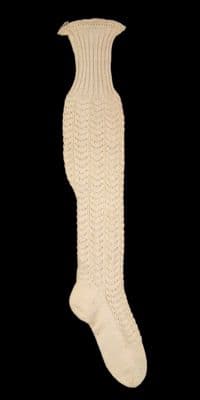
These two pieces reveal how knitting's democratic nature allowed the same fundamental techniques to serve radically different social registers in Victorian America. The cream stockings, with their disciplined ribbing and pristine uniformity, represent the respectable middle-class ideal of restrained elegance, while the colorwork bootees burst with the kind of exuberant folk patterns that immigrant communities brought from Scandinavia and Eastern Europe.
VISUAL ECHO60 years · cross-culture
Text70%
Image83%
Entity
Echoes Across Time
Empire / Regency → Victorian Late / Bustle · 60yr50%
LINEAGE
These two pieces trace the migration of European folk knitting across the Atlantic, where intricate cable patterns gave way to bold colorwork storytelling. The English mittens display the mathematical precision of Aran-style cables—those interlocking diamonds and twisted stitches that required memorized sequences passed down through generations—while the American bootees translate that same domestic virtuosity into pictorial motifs, trading structural complexity for narrative charm.
Technique·knitting
Victorian Late / Bustle → Empire / Regency
Pull the Thread→
Follow this garment wherever the graph leads