THE MET
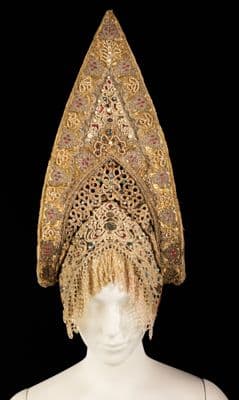
Golden Silk Kokoshnik Headdress with Metallic Thread
Neoclassical Transition · 1780s · Russian
Production
handmade
Material
silk with metallic thread
Culture
Russian
Influences
traditional Russian kokoshnik · Byzantine imperial regalia
A towering Russian kokoshnik headdress featuring an elaborate pointed silhouette that extends dramatically upward. The entire surface is covered in intricate metallic embroidery worked in gold thread on cream silk, creating dense geometric and floral patterns. The embroidery includes scrolling vine motifs, stylized flowers, and lattice-work designs that cover every inch of the visible surface. Long silk fringe dangles from the lower edge, creating movement and texture. The construction appears rigid, likely built over a foundation that maintains the dramatic triangular shape. This represents the height of Russian court fashion during Catherine II's reign, combining traditional Russian headwear forms with the elaborate decorative sensibilities of the late 18th century.
headband/head covering/hair accessory
Connected To
65%
Worn with·jewelryTechnique·hand-embroideryFunction·court-formal
SHARED90 years · cross-culture
These two pieces reveal how lace became the great democratizer of feminine ceremony across cultures and classes. The Russian kokoshnik's golden threads form the same intricate web patterns as the American evening cap's black silk net—both using openwork to create drama through negative space rather than solid mass.
Text60%
Image73%
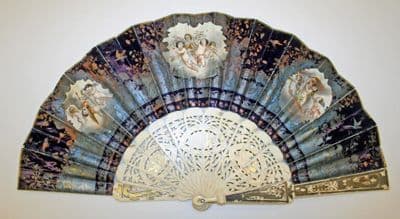
Technique·hand-embroideryTechnique·metalworkFunction·court-formal
SHARED30 years · cross-culture
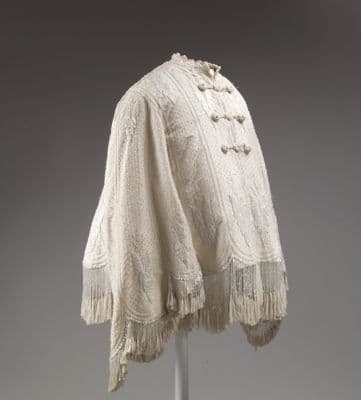
Technique·couture-constructionFunction·court-formal
SHARED110 years · cross-culture · cross-category
Text52%
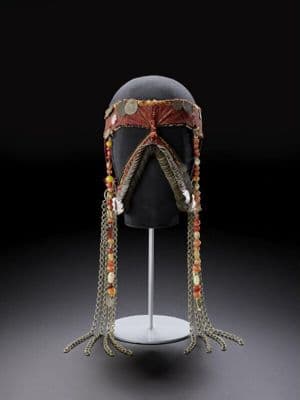
49%
Technique·hand-embroideryTechnique·metalwork
SHARED160 years · cross-culture
Text45%
Echoes Across Time
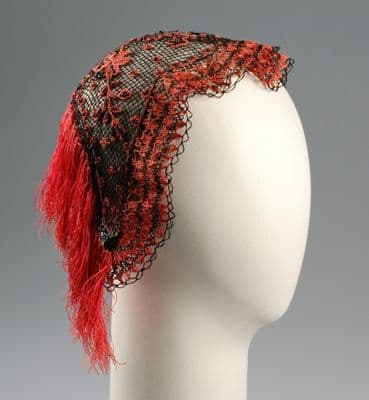
Neoclassical Transition → Victorian Late / Bustle · 90yr65%
SHARED
These two pieces reveal how lace became the great democratizer of feminine ceremony across cultures and classes. The Russian kokoshnik's golden threads form the same intricate web patterns as the American evening cap's black silk net—both using openwork to create drama through negative space rather than solid mass.
Worn with·jewelryTechnique·hand-embroideryFunction·court-formal
Pull the Thread→
Follow this garment wherever the graph leads