THE MET
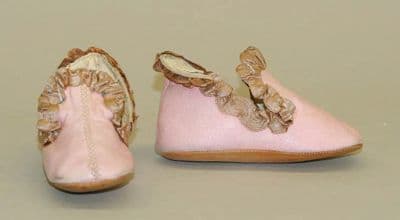
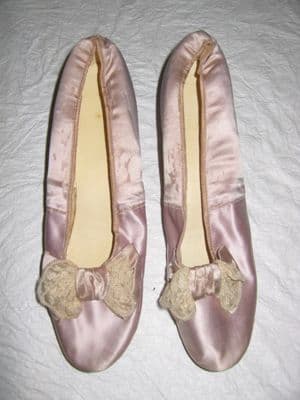
Pale Pink Silk Satin Pointed-Toe Evening Slippers
Victorian Late / Bustle · 1870s · American or European
Production
handmade
Material
silk satin
Culture
American or European
These delicate evening slippers feature pale pink silk satin uppers with sharply pointed toes characteristic of 1870s footwear. The shoes are constructed with low-cut fronts that would expose the instep, secured by narrow ankle straps with small buckles or ties. Decorative gold and cream silk ribbon trim edges the topline and straps, creating subtle contrast against the pink base. The construction appears to be lightweight with thin leather soles suitable for indoor wear. The pointed toe shape reflects the fashionable silhouette of the bustle era, when shoes became increasingly narrow and refined to complement the period's emphasis on vertical lines and structured elegance.
shoe
Connected To
Worn with·evening gownTechnique·leather-workingFunction·court-formal
SHAREDsame era · cross-culture · cross-category
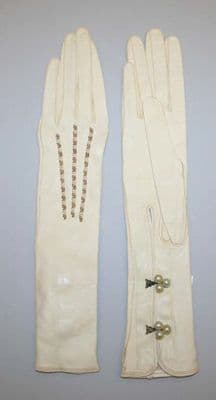
These cream kid gloves and pink satin slippers speak the same language of Victorian evening refinement, where every extremity demanded its own jewel-like perfection. The gloves' delicate cutwork ventilation and tiny metal clasps mirror the slippers' precious ribbon rosettes and pointed silhouette—both crafted with the obsessive attention to detail that marked formal dress when being properly equipped for an evening meant armoring yourself in beauty from fingertip to toe.
Text63%
Image75%
Worn with·evening gownWorn with·stockings
SHARED15 years · cross-culture
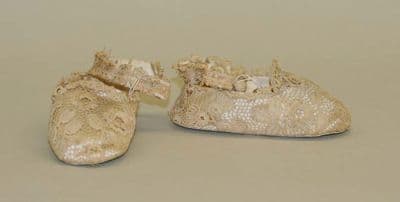
These delicate slippers trace the evolution of Victorian evening footwear from the crinoline era's ornate excess to the bustle period's streamlined refinement. The earlier cream brocade pair, with its elaborate floral weaving and gathered ribbon ties, speaks to mid-century maximalism when feet peeking from voluminous skirts demanded decorative impact.
Worn with·evening gownWorn with·stockings
SHARED10 years · cross-culture
These pale pink satin slippers, separated by a decade and an ocean, reveal how the Victorian obsession with dainty femininity created its own rigid uniform.
Worn with·stockingsTechnique·leather-workingFunction·court-formal
SHARED130 years · cross-culture
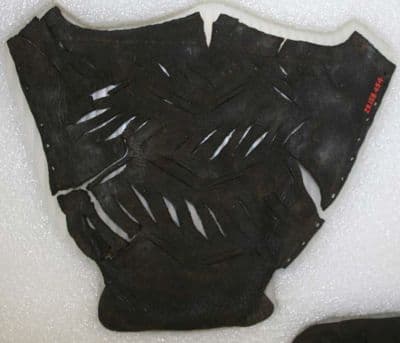
These shoes are separated by over a century but united by the aristocratic impulse to make even the most mundane surface a canvas for excess. The earlier black leather pair transforms the foot into something almost reptilian through its aggressive slashing—each cut revealing glimpses of what lies beneath, a technique borrowed from 16th-century doublets that spoke of wealth through deliberate destruction of expensive materials.
Echoes Across Time
Rococo → Victorian Late / Bustle · 130yr56%
SHARED
These shoes are separated by over a century but united by the aristocratic impulse to make even the most mundane surface a canvas for excess. The earlier black leather pair transforms the foot into something almost reptilian through its aggressive slashing—each cut revealing glimpses of what lies beneath, a technique borrowed from 16th-century doublets that spoke of wealth through deliberate destruction of expensive materials.
Worn with·stockingsTechnique·leather-workingFunction·court-formal
Pull the Thread→
Follow this garment wherever the graph leads