THE MET
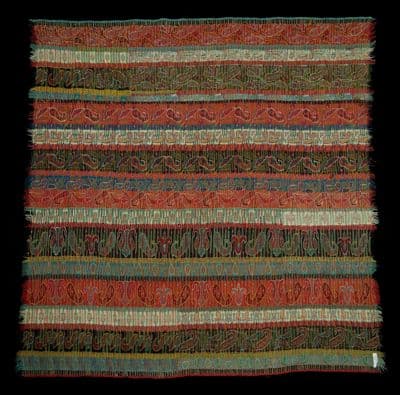
Red Green Cream Wool Paisley Shawl
Victorian Early / Crinoline · 1850s · American
Production
mass-produced
Material
wool
Culture
American
Influences
Kashmir shawl tradition
A rectangular wool shawl displaying horizontal bands of alternating paisley and geometric patterns in rich earth tones. The textile features intricate woven designs with dominant red and green paisley motifs separated by narrower bands of cream and brown geometric patterns. The shawl shows characteristic mid-19th century American textile production with machine-woven construction creating complex multicolored patterns. Fringed edges complete the perimeter, typical of period shawl finishing. The dense patterning and color palette reflect the Victorian preference for ornate textiles, while the rectangular format indicates practical everyday use rather than the triangular format of formal Kashmir shawls.
scarf
Connected To
Influences·Kashmir shawl traditionTechnique·jacquard-weavingTechnique·machine-weavingMotif·paisley
SHARED50 years · cross-culture
The paisley's journey from Kashmir to Victorian parlor is written in these two shawls: the earlier white cotton piece whispers its motifs along the border like a cautious translation, while the later wool example shouts the pattern across every inch in saturated reds and greens. Fifty years and an industrial revolution separate them, transforming the paisley from precious accent to democratic abundance.
Text86%
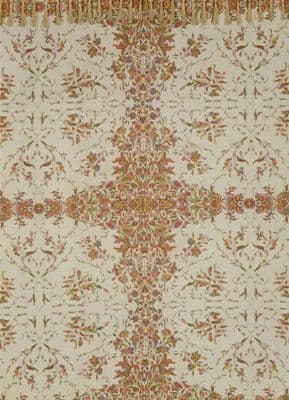
Technique·jacquard-weavingTechnique·machine-weavingMotif·paisley
SHARED10 years · cross-culture
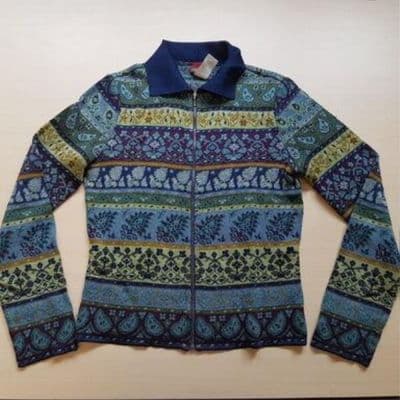
Technique·jacquard-weavingTechnique·machine-weaving
SHARED140 years · cross-culture · cross-category
Text51%
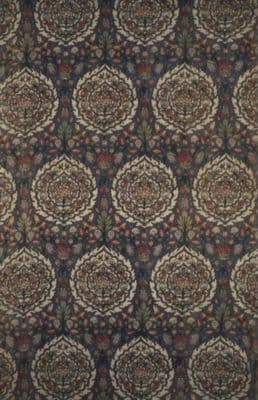
Technique·jacquard-weavingMotif·paisley
SHARED110 years · cross-culture · cross-category
Text61%
Echoes Across Time
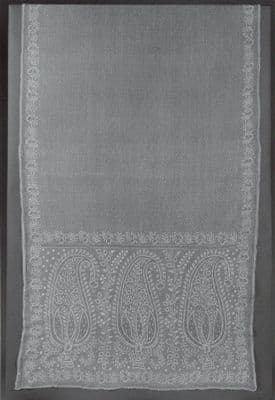
Victorian Early / Crinoline → Empire / Regency · 50yr72%
SHARED
The paisley's journey from Kashmir to Victorian parlor is written in these two shawls: the earlier white cotton piece whispers its motifs along the border like a cautious translation, while the later wool example shouts the pattern across every inch in saturated reds and greens. Fifty years and an industrial revolution separate them, transforming the paisley from precious accent to democratic abundance.
Influences·Kashmir shawl traditionTechnique·jacquard-weavingTechnique·machine-weaving
Pull the Thread→
Follow this garment wherever the graph leads