THE MET
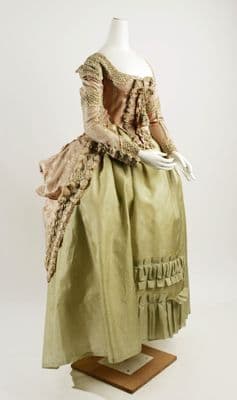
Sage Green Silk Taffeta Robe à la Circassienne
Neoclassical Transition · 1780s · French
Production
handmade
Material
silk taffeta
Culture
French
Movement
Anglomania
Influences
Turkish costume inspiration · pastoral romanticism
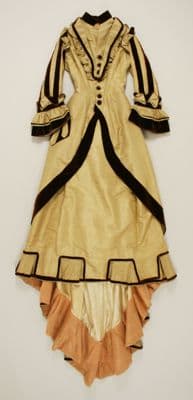
This robe à la circassienne features a fitted golden-brown silk bodice with square neckline and three-quarter sleeves ending in multiple tiers of pleated ruffles. The bodice is elaborately trimmed with serpentine bands of self-fabric ruching and decorative bows. A sage green silk underskirt extends to floor length, while the brown overskirt is caught up asymmetrically at the sides and back, creating characteristic draped swags. The green underskirt is embellished with horizontal bands of knife pleating near the hem. This style represents the transitional period between Rococo excess and emerging neoclassical simplicity, combining structured tailoring with romantic draping that would influence later Empire silhouettes.
dressfit and flaresquare necklinefloor length
Connected To
59%
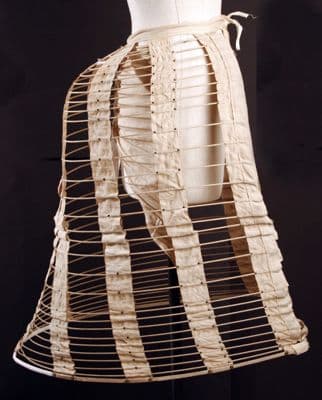
Worn with·chemiseWorn with·pocket hoops
SHARED10 years · cross-culture
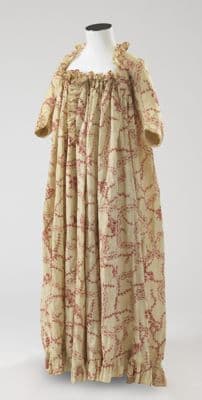
These two gowns capture the precise moment when fashion's center of gravity shifted from England's chintz-mad drawing rooms to France's neoclassical salons. The earlier English sack-back gown, with its cascading watteau pleats and busy floral chintz, represents the Rococo's love affair with botanical excess and loose, unstructured silhouettes.
Echoes Across Time
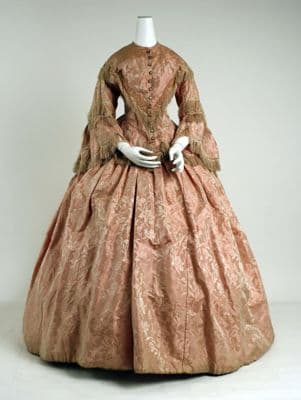
Neoclassical Transition → Victorian Early / Crinoline · 70yr56%
SHARED
These two gowns capture the precise moment when 18th-century excess began its slow retreat into 19th-century propriety. The earlier sage green robe à la Circassienne still carries the theatrical DNA of court dress—that cascade of ruffled trim down the bodice, the way fabric pools and gathers with Rococo abandon—but notice how the silhouette has already started to elongate and simplify compared to the extreme panniers of earlier decades.
Worn with·chemiseWorn with·corsetFunction·court-formal
Pull the Thread→
Follow this garment wherever the graph leads