V&A
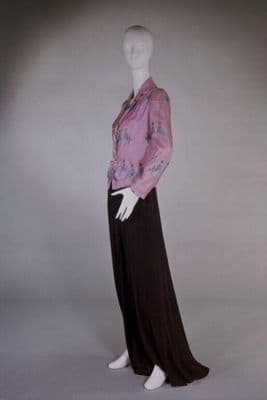
Dusty Rose Silk Twill Evening Blouse
Great Depression · 1930s · French
Production
haute couture
Material
silk twill
Culture
French
Influences
bias-cut technique · Parisian haute couture
This 1938 Parisian evening ensemble demonstrates the sophisticated bias-cutting techniques characteristic of 1930s haute couture. The jacket features a fluid, unstructured silhouette in dusty rose silk twill with burgundy trim details along the lapels and front closure. The fabric drapes naturally across the torso, following the body's curves without rigid construction. The accompanying skirt is cut on the bias in black silk, creating a long, column-like silhouette that skims the body and flows to floor length. The ensemble exemplifies the era's preference for elegant simplicity and the technical mastery of bias-cutting that allowed fabrics to move gracefully with the wearer's form.
blouseregular fitv-neckhip length
Connected To
Technique·bias-cutting
LINEAGEsame era · cross-culture · cross-category→ directed
Lineage: “bias-cutting technique from Madeleine Vionnet”
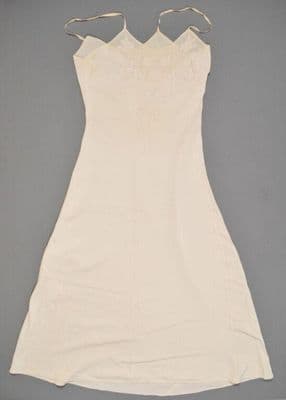
That dusty rose blouse and cream slip are both children of Madeleine Vionnet's revolutionary bias-cutting technique, which liberated 1930s women from the rigid corseted silhouettes of previous decades. The blouse's fluid drape across the torso and the slip's sinuous cling to the body both exploit fabric cut on the diagonal, allowing silk to move like liquid rather than armor.

Pull the Thread→
Follow this garment wherever the graph leads