1950s · 1950s · French
Production
mass-produced
Material
printed cotton jersey
Culture
French
Movement
New Look / Post-War
Influences
1950s children's casual wear · American sportswear influence
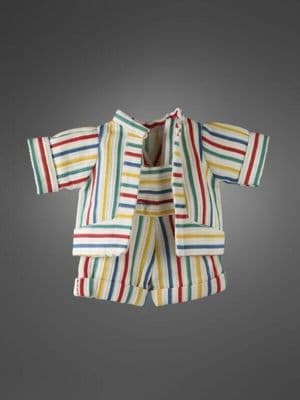
A miniature two-piece ensemble for the French Bleuette doll featuring a short-sleeved shirt and matching shorts in printed cotton jersey. The fabric displays horizontal stripes in primary colors of red, blue, and yellow on a white ground. The shirt has a simple pullover construction with set-in sleeves and appears to have a round neckline. The shorts are cut in a relaxed, straight-leg style typical of children's casual wear from the early 1950s. The garment construction shows machine-sewn seams appropriate for doll clothing production. This ensemble reflects the post-war shift toward more casual, practical children's clothing, translated into miniature scale for the popular French fashion doll market.
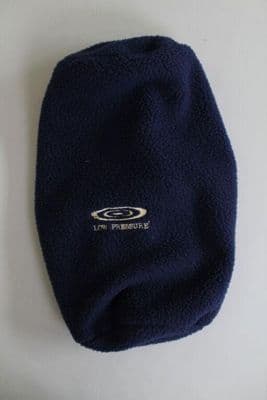
The navy fleece beanie's utilitarian minimalism and that crisp striped doll outfit might seem worlds apart, but they're both children of American sportswear's great democratization — the idea that clothes should move with you, not against you. The beanie's technical fleece and the doll's jersey stripes both reject the stiff formality that once ruled their respective domains (adult headwear, children's dress-up), choosing instead the easy functionality that sportswear taught the world to crave.


The navy fleece beanie's utilitarian minimalism and that crisp striped doll outfit might seem worlds apart, but they're both children of American sportswear's great democratization — the idea that clothes should move with you, not against you. The beanie's technical fleece and the doll's jersey stripes both reject the stiff formality that once ruled their respective domains (adult headwear, children's dress-up), choosing instead the easy functionality that sportswear taught the world to crave.


Follow this garment wherever the graph leads
Lineage: “1950s nautical styling”
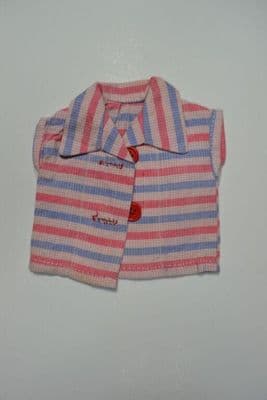
These two French doll outfits from the 1950s trace the journey of nautical stripes from seaside practicality to domestic charm. The first ensemble—with its bold horizontal bands in primary colors and sailor-suit proportions—channels the crisp authority of maritime uniforms, while the second softens that same stripe language into pastel pink and blue, trading the sailor's structured silhouette for a genteel blouse with tiny pearl buttons.
Lineage: “1950s casual separates”
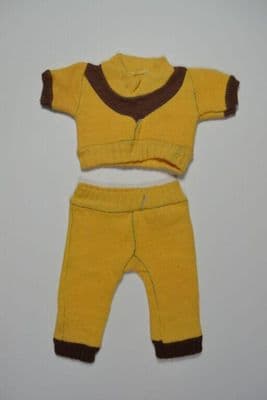
These two 1950s French doll outfits capture the decade's twin obsessions: the crisp geometry of mid-century modernism in that striped set's clean lines and primary colors, versus the cozy domesticity of the mustard cardigan ensemble with its brown ribbed trim that whispers "suburban comfort." The striped piece reads like a miniature Mondrian painting translated into playwear, while the yellow set—with its practical snap-front cardigan and matching pants—mirrors the era's new casual separates tha.
Lineage: “1950s children's casual wear”
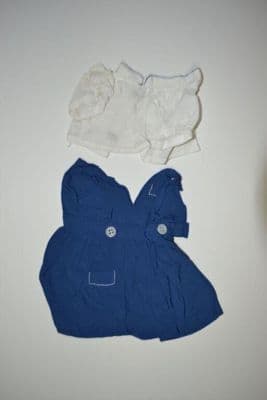
These two 1950s French children's ensembles reveal how postwar optimism played out in miniature wardrobes, one through crisp nautical authority, the other through carnival-bright rebellion. The navy set channels grown-up sophistication with its military-inspired double-breasted jacket and structured silhouette, while the striped jersey outfit tosses that formality aside for the kind of rainbow stripes that practically vibrate with childhood energy.
That 1950s French striped set is the genetic ancestor of every oversized striped shirt that's ever walked down a sidewalk—those clean horizontal bands in primary colors established the visual grammar that the contemporary tunic still speaks fluently. The distance between them is the difference between a child's coordinated outfit and grown-up nonchalance, but the DNA is identical: those democratic stripes that make getting dressed feel effortless.