SMITHSONIAN
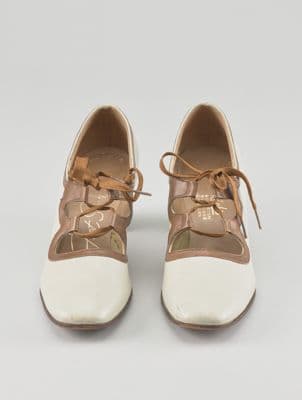
Cream and Brown Two-Tone Oxford Pumps
1950s · 1950s · American
Production
ready-to-wear
Material
leather
Culture
American
Movement
New Look / Post-War
Influences
Oxford shoe tradition · 1940s spectator shoe styling
These are two-tone oxford pumps featuring cream leather toe caps and brown leather uppers with decorative perforated detailing. The shoes have a classic lace-up closure with thin brown leather laces threaded through metal eyelets. The construction shows clean lines typical of 1950s footwear, with a moderate heel height and rounded toe shape. The brown leather displays subtle brogue-style perforations along the seams where it meets the cream sections. The overall silhouette is streamlined and practical, reflecting the post-war emphasis on refined yet accessible fashion that characterized women's footwear during the New Look era.
shoe
Connected To
Influences·Oxford shoe traditionTechnique·leather-working
SHARED10 years · cross-culture
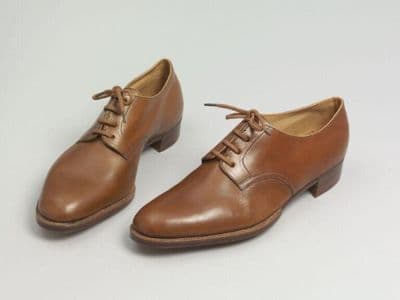
These shoes trace the evolution of wartime pragmatism into postwar optimism through the enduring Oxford silhouette. The brown utility oxfords, with their sturdy single-tone leather and no-nonsense lacing, embody the make-do mentality of the 1940s—when leather was precious and ornamentation was frivolous.
Text75%
Image85%
Entity43%
Technique·leather-working
LINEAGE70 years · cross-culture→ directed
Lineage: “Oxford shoe tradition”
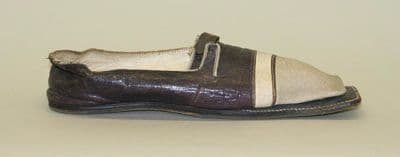
The Victorian oxford's stark black-and-cream geometry laid the blueprint for mid-century America's obsession with two-tone shoes, but look how the proportions shifted: where the 1880s shoe cuts its contrast in bold, architectural blocks, the 1950s pair softens everything into curves and gentle transitions.
Movement·New Look / Post-WarTechnique·leather-working
SHAREDsame era · cross-culture
Text56%
Technique·leather-working
LINEAGE60 years · cross-culture→ directed
Lineage: “1950s stiletto heel innovation”
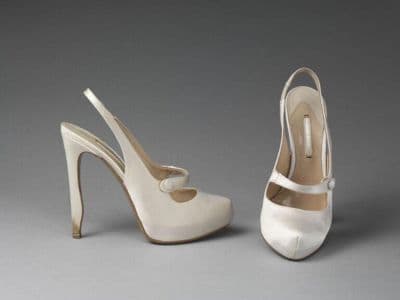
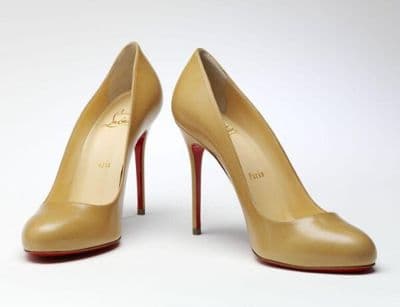
These two pumps trace the evolution of feminine power dressing through the language of the heel. The 1950s oxford pump, with its sturdy lace-up closure and modest height, speaks to an era when women borrowed masculine codes to claim professional space—notice how that cream and brown colorblocking mimics men's spectator shoes, but the curved heel announces its wearer's refusal to disappear entirely.
Echoes Across Time
Victorian Late / Bustle → 1950s · 70yr47%
LINEAGE
The Victorian oxford's stark black-and-cream geometry laid the blueprint for mid-century America's obsession with two-tone shoes, but look how the proportions shifted: where the 1880s shoe cuts its contrast in bold, architectural blocks, the 1950s pair softens everything into curves and gentle transitions.
Technique·leather-working
1950s → 2020s · 60yr45%
LINEAGE
Pull the Thread→
Follow this garment wherever the graph leads